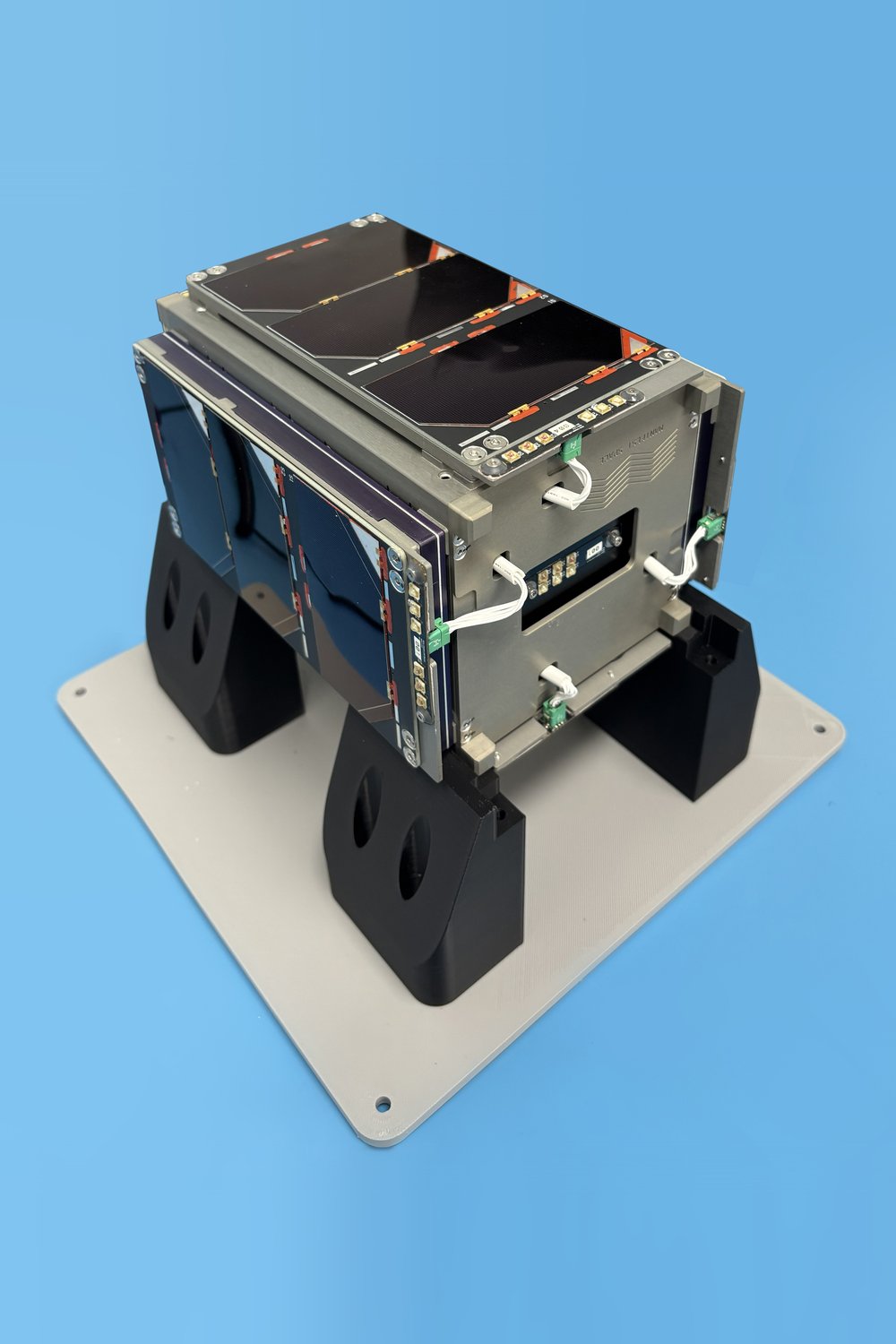
When the Alabama Space Accelerator launched in Huntsville this fall, we wrote about what it means for Tennessee as a neighbor and a competitor for the same founders. But the more interesting story may be underneath the program itself: how Alabama actually paid for it. The accelerator runs on a state tax credit, not a grant or a line item in the state budget — and that's one of several very different models states are using to fund their innovation economies right now.
Tennessee competes with Alabama, North Carolina, Florida, Ohio, Virginia, Colorado, and Georgia for the same companies, the same federal contracts, and increasingly the same space-industry investment. Understanding how those states pay for their own innovation infrastructure is directly useful for thinking about what Tennessee does next.
The Models States Use
Strip away the branding and most state innovation-funding programs boil down to a handful of mechanisms:
- Direct Funding / Grants — the state (or a state-chartered nonprofit) writes a check directly to a company, university, or program operator.
- Tax Credit — the state doesn't spend cash itself. It lets taxpayers redirect a portion of what they already owe to an approved project, and gives up the tax revenue instead. Alabama's model.
- LP / Fund Investment — the state acts like a limited partner, putting public (often federal) capital into venture funds or co-investing directly in companies alongside private investors.
- SBIR/STTR Matching — the state matches money that companies have already won from federal Small Business Innovation Research or Small Business Technology Transfer awards, stretching federal dollars further.
- Infrastructure & Tax Exemption — less common, but notably how Florida approaches space: financing facilities and equipment and waiving taxes rather than writing checks or credits.
Most states mix two or three of these. Here's how the ones we looked at line up:
| State | Flagship Program | Direct Funding | Tax Credit | LP / Fund Investment | SBIR/STTR Matching | Notes |
|---|---|---|---|---|---|---|
| Alabama | Innovate Alabama Tax Credit | — | ✓ | — | — | Donor-directed; funded the Alabama Space Accelerator |
| Tennessee | LaunchTN / InvestTN | ✓ | — | ✓ | ✓ | Three-fund structure plus SBIR/STTR matching and TTAC grants |
| North Carolina | One NC Small Business Program / NC IDEA | ✓ | — | — | ✓ | State SBIR matching plus a separately run private grant foundation |
| Florida | Space Florida | — | — | — | — | Its own category: conduit financing, tax exemptions, land/infrastructure access |
| Ohio | Ohio Third Frontier | ✓ | — | — | — | Matching grants to universities/research institutions, then direct startup awards |
| Virginia | Virginia Innovation Partnership Corporation | ✓ | — | ✓ | ✓ | Virginia Venture Partners is the fund-of-funds arm |
| Colorado | OEDIT Advanced Industries Accelerator | ✓ | — | — | — | Grants only, targeted at aerospace, advanced manufacturing, bioscience, and more |
| Georgia | Georgia Research Alliance | ✓ | — | ✓ | — | Primarily university research capacity; GRA Venture Fund invests in campus spinouts |
Table reflects each program's primary, publicly documented mechanisms as of November 2026 and is not exhaustive of every state incentive.
Alabama's Tax Credit, in Depth
Alabama's approach is worth a closer look because it solves a specific, boring, and important problem: who pays the people who actually run an accelerator — recruiting founders, lining up mentors, and turning introductions into contracts? Alabama decided the state didn't need to write that check itself. Instead, it built a system where taxpayers choose to write it, in exchange for a dollar-for-dollar credit against what they already owe the state.
How it works
Say a company owes $1 million in eligible Alabama tax. It reserves a $500,000 credit against an approved project, then sends that $500,000 in cash directly to the organization running the project. Once the contribution is confirmed, the company's tax bill drops by the same $500,000. The project gets an operating budget, the donor picks which approved project to support, and the state gives up $500,000 in revenue it otherwise would have collected. No appropriation, no line item — the "spending" happens entirely through the tax code.
The law lives in Title 41, Chapter 10, Article 22 of the Code of Alabama. A few provisions do most of the work: one lets qualifying economic development organizations apply to run an accelerator or similar program; one gives Innovate Alabama — the state's innovation agency — authority to approve each project and set its funding cap; one caps total statewide approvals at $25 million per year, reserves at least $10 million of that for the innovative-company category, lets a donor offset up to 50% of eligible tax liability, and allows unused credit to carry forward for five years; and one sets July 31, 2028 as the current deadline for new project approvals.
The mechanics are tightly timed. An organization gets designated, then applies project-by-project. Once the Department of Revenue opens a project for reservations, donors have 30 days to reserve credits first-come, first-served, then 21 days to actually wire the cash. The organization has 60 days to confirm it received the money and intends to proceed — and funds can be recaptured if it doesn't follow through.
Where the money has gone
The Alabama Space Accelerator is the newest and, for our audience, most relevant example — state approval records show the Apollo Coalition, which runs the accelerator alongside Treble One, received two approvals in 2026: $165,000 in June and $1.625 million in August, with Blue Cross and Blue Shield of Alabama identified as a funder. The program isn't limited to space and defense, though. The 2025 approval round included roughly $1.28 million for Innovation Portal, which runs the gBETA Gulf Coast accelerator, $2.5 million for Bronze Valley, $1.8 million for Opportunity Alabama's defense accelerator, and just over $1 million for its biomanufacturing program. In the Wiregrass region, Grow Southeast Alabama used the same credit to launch a forestry and natural-resources accelerator through HudsonAlpha's Wiregrass Innovation Center — proof the model travels well beyond any one industry.
What the early numbers say
In 2025, Innovate Alabama approved 21 of 27 project applications. Eligible requests totaled $31.1 million against a $25 million cap, meaning the program hit its ceiling with room to spare in demand. The state's own report projects 913 direct jobs and roughly 168 indirect and induced jobs tied to approved projects — projections, not confirmed outcomes, and a fair thing for Alabama lawmakers to check against reality before the program's 2028 sunset.
Tennessee's Own Toolkit
Tennessee doesn't run a donor-directed tax credit like Alabama's — that's a real gap worth naming — but LaunchTN already runs a more varied toolkit than it might get credit for. Its current flagship is InvestTN, a $64 million, federally backed (SSBCI 2.0) structure split into three funds: a $28 million Regional Seed Fund making $25,000–$250,000 direct investments through seven regional entrepreneur centers, a $36 million Growth Fund investing $250,000–$3 million from seed through Series B, and a $6 million Multi Fund that commits $1–3 million as a true limited partner into outside VC funds (fully deployed as of this writing). All three require at least a 1:1 private match. Separately, LaunchTN runs an SBIR/STTR Matching Fund and, through the Tennessee Technology Advancement Center, Proof of Concept and technology maturation grants. Tennessee also ran an earlier LP-style vehicle, the INCITE Co-Investment Fund, under Governor Haslam; it was fully deployed by 2018, and InvestTN is effectively its successor.
In other words, Tennessee already covers direct funding, LP/fund investment, and SBIR matching. The one lever in Alabama's kit that Tennessee doesn't have is the tax credit — a mechanism that, unlike a state-funded program, scales with private-sector willingness to give and doesn't compete with other priorities for appropriated dollars.
What This Means for Tennessee
None of these models is obviously "best." A tax credit like Alabama's needs willing corporate donors and a broad enough set of eligible taxes to attract them — Alabama's reaches insurance premium and utility license taxes specifically so it isn't limited to companies that pay corporate income tax. An LP/fund model like InvestTN's needs enough private co-investment to make the match requirement work. Grant-only models like Ohio's and Colorado's are simpler to administer but depend entirely on continued appropriations.
What the Alabama Space Accelerator shows is that the tax-credit model can fund something as specific and space-focused as a ten-week, zero-equity accelerator aimed squarely at Huntsville's federal and commercial buyers — without a single new budget line. As Tennessee's own space ecosystem matures past Space-Edge's pre-accelerator stage, a similar instrument, purpose-built for space and defense founders working toward their first contracts, is a model worth Tennessee studying closely. TN Space will keep tracking how Alabama's approach performs as it heads toward its 2028 sunset, and what it would take to bring something like it here.